Workshops
SWISS MILKY WAY
PHOTOGRAPHY WORKSHOP
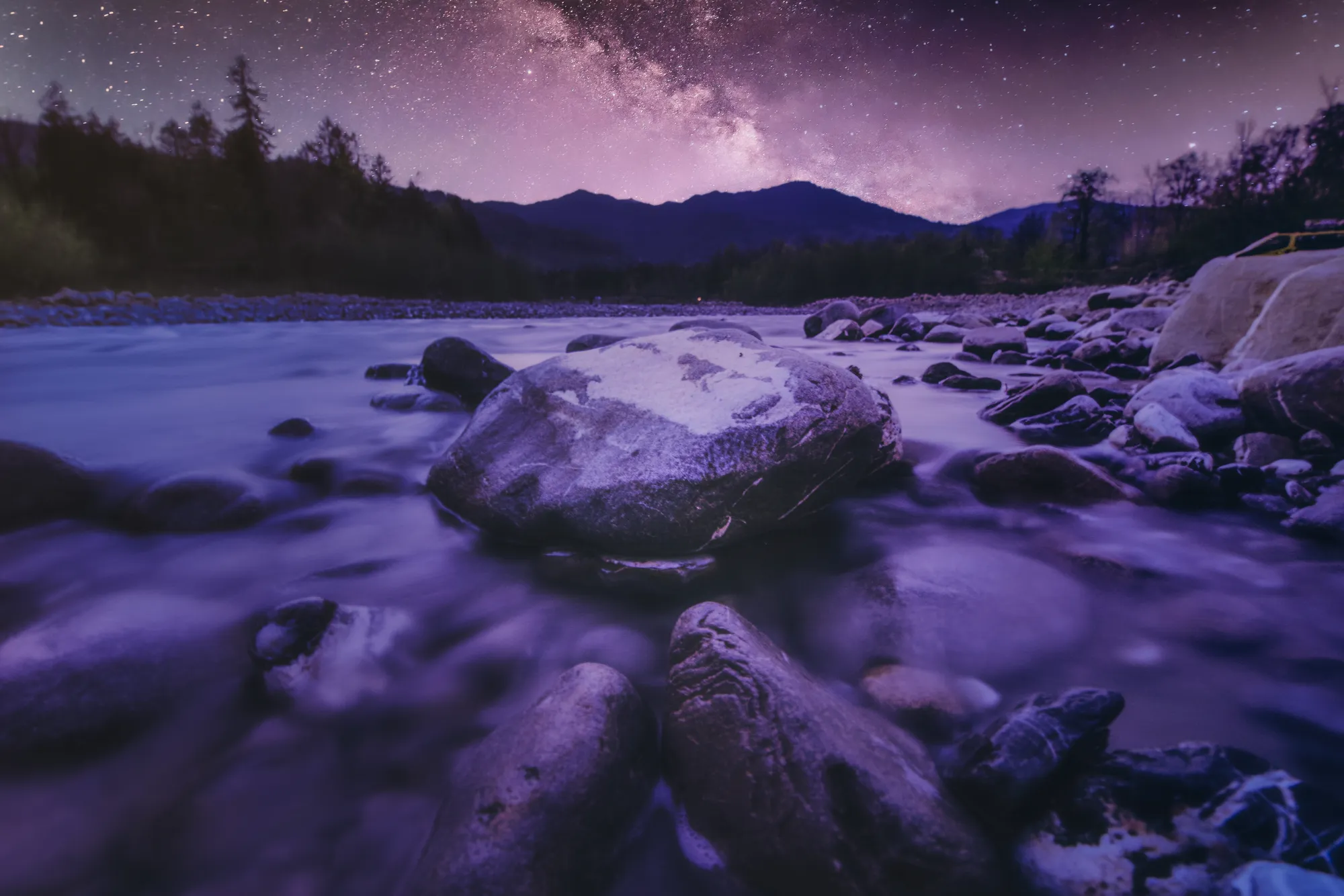
A small-group night out under dark alpine skies, photographing the Milky Way from some of Switzerland's best vantage points — beginner friendly, minimal gear required.
Request a spotWhat this is
Learn to shoot the night sky, hands-on
This workshop takes a small group out to a dark-sky location in the Swiss Alps for an evening focused entirely on photographing the Milky Way. Rather than a lecture, it is a hands-on evening on location — working through composition, exposure settings and focusing technique for the specific conditions of the night.
No prior astrophotography experience is required. The pace is adapted to whoever is there, from a first attempt at night photography to refining an existing routine.
When it happens
Night, dark skies and clear weather
This is a night-time workshop. It only goes ahead when the Milky Way is actually visible — that means clear weather and a suitable time of year and moon phase. It usually means travelling well into the mountains, away from light pollution, with a clear view toward the south-west.
Because of this, every workshop is planned individually around conditions rather than fixed on a set calendar date. Get in touch and dates and timing are worked out together, ideally with a bit of lead time.
Each night is calculated individually — checking when the galactic core is above the horizon during astronomical darkness and the moon is below it, for at least 30 minutes. Nights are grouped into expandable phases, roughly one per lunar month. Window length and timing vary a lot by latitude and season. Weather only shows once a forecast is available (up to about 5 days ahead). This calendar recalculates itself from today's date, so it never runs out.
Calculating upcoming dates…
Times and orientation are calculated for the selected location using standard astronomical formulas, not minute-exact for one specific spot — use Sun Surveyor to check the precise position for the night and location once a date is set. Weather forecast: MeteoSwiss ICON-CH2 for Switzerland, Open-Meteo's best available model for other locations.
"Notify me if it looks good" is a new beta feature — if you run into any errors enabling it, please let me know at florian.thalmann@gmail.com.
Plan ahead
Sky events 2026 – 2027
The most noteworthy sky events for photography in Switzerland from August 2026 through July 2027 — eclipses, meteor showers and planetary oppositions, roughly in order.
Eclipses
Tap for dates ↓
- Partial solar eclipse — 12 August 2026. Around 91% coverage across most of Switzerland, peaking at 20:18 (up to 92% in Valais). The sun is very low and close to setting, so a clear view toward the west-northwest is essential. A certified solar filter (ISO 12312-2) is required in front of the lens — the total eclipse itself is only visible from Greenland, Iceland and northern Spain.
- Partial lunar eclipse — 28 August 2026. Begins around 04:30 in the morning — an early one for early risers.
Meteor showers
Tap for dates ↓
- Perseids — night of 12/13 August 2026. Up to 100 meteors/hour under excellent, moon-free conditions this year — the best shower of the season.
- Draconids — night of 8/9 October 2026.
- Orionids — night of 21/22 October 2026. Around 20/hour.
- Leonids — night of 16/17 November 2026. Around 15/hour.
- Geminids — night of 13/14 December 2026. Up to 150 meteors/hour with barely any moonlight — the strongest shower of the year.
- Quadrantids — early January 2027.
- Lyrids — night of 22/23 April 2027.
Planets best for telescope shots
Tap for dates ↓
- Saturn at opposition — 4 October 2026. Visible all night and at its brightest.
- Neptune at opposition — 26 September 2026.
- Uranus at opposition — 25 November 2026.
- Jupiter at opposition — 11 February 2027. Magnitude −2.5, bright in Leo.
- Mars at opposition — 19 February 2027.
Tip: the Perseids and Geminids are the two richest meteor nights — for both, head somewhere dark away from light pollution (Jura, the Alps). For the solar eclipse, use a solar filter in front of the lens, never look at it directly. The Saturn and Jupiter oppositions are good telescope targets, since the planets are then at their closest and brightest.
What you need
Just a tripod and a camera
Only two things are required: a sturdy tripod and a digital camera with a lens somewhere in the 15–50mm range that allows manual exposure control. No specialist astro equipment, star trackers or filters are needed for this workshop.
No camera of your own? Loaner gear — an Olympus OM-D E-M5 Mark II with a Voigtländer 10.5mm, an Olympus 7–14mm f/2.8 PRO or a Panasonic 20mm f/1.7, plus a tripod — is available for up to 2 participants per session on request when booking. It's older, well-used gear meant for a first taste of astrophotography rather than a professional setup — plenty capable for that.
If you are unsure whether your current setup is suitable, get in touch beforehand and it can be checked together.
For your own preparation, the app Sun Surveyor is a useful way to check where and when the Milky Way will be visible. If you already have a specific location in mind, let me know — your own location ideas are welcome and can be considered when planning the workshop.
A rough guide to what works well versus what's just about workable, plus a simple calculator below to check a specific combination.
Milky Way long exposure Try your own combination
| Level | Focal length | Aperture | ISO | Shutter speed |
|---|---|---|---|---|
| Optimal | 14–24mm | f/1.4–f/2.0 | 1600–3200 | 15–20s |
| Good | 24–35mm | f/2.0–f/2.8 | 3200–6400 | 10–15s |
| Minimum / workable | 35–50mm | f/2.8–f/4.5 | 6400–12800 | 5–10s |
A simplified planning guide, not a substitute for checking the result on the back of the camera — actual noise performance varies a lot by camera body.
ND filter exposure
Assumes standard reciprocity — very long exposures on some cameras or film may need extra compensation.
Star trail exposure
Shooting one continuous long exposure risks heat noise and battery limits — stacking many shorter frames in software gives a cleaner result for the same total arc.
On location
Composition and camera settings, together
Once on site, the composition is worked out together, and camera settings are reviewed and adjusted as a group before taking the photo — covering aperture, shutter speed, ISO and focusing for the specific location and conditions of the night.
Good to know
Practical details
Getting to the location and travel insurance are each participant's own responsibility. Locations are typically in alpine terrain reached partly on foot, often in the dark — suitable footwear and clothing for mountain conditions at night are essential.
Every workshop needs to be planned in advance around weather and Milky Way visibility, so it isn't something that can be booked spontaneously for a fixed date. For questions about timing and likely dates, just get in touch directly.
Groups are kept small, typically 2–4 participants. Typical time on location is around 2–3 hours, adjusted to the Milky Way's visibility window for that specific date and season (see the calendar above). Participants must be at least 16 years old (under-18s accompanied by an adult). Payment is in cash or via TWINT on the evening itself — no deposit needed to book. If a session is cancelled due to weather, it simply needs to be rebooked for another date, at no cost either way. Full details in the workshop terms.
Interested?